Answers live in people's heads
New staff take months to become productive because the knowledge was never written down where it can be found.
Solutions · Internal knowledge
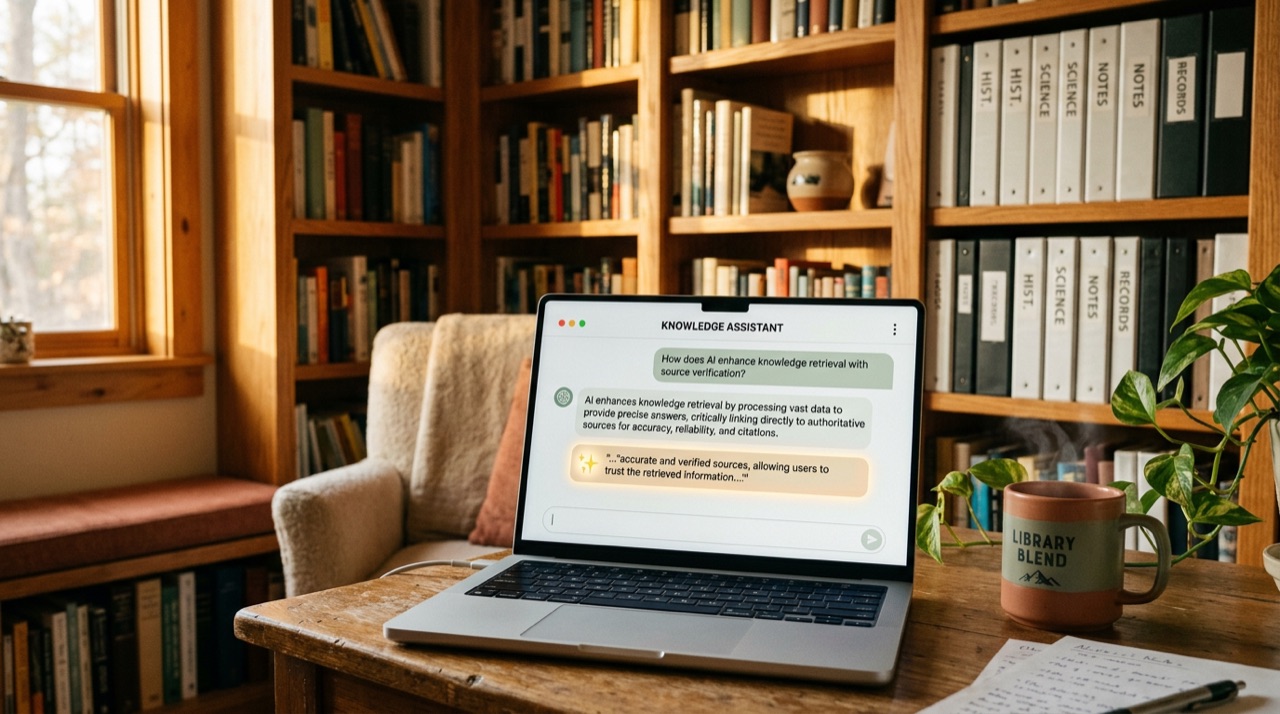
When the answer lives in someone's head, every new starter costs a senior person's time and every absence becomes a bottleneck. We build retrieval over your own documents — with the source shown on every answer, so it can be verified.
The problem
New staff take months to become productive because the knowledge was never written down where it can be found.
Reaching the right procedure mid-task is slower than asking a colleague, so procedures are bypassed.
Staff get a list of files across several systems and still have to read them to find the line that matters.
What we build
Every one of these is described as a business workflow, not an AI feature. Each is scoped, measured and deployed the same way.
Company knowledge assistants
Staff can ask the business a question and get an answer grounded in your own documents.
Policy retrieval
The current policy, not the version someone saved locally two years ago.
Procedure retrieval
The right procedure surfaced at the moment of the task.
Product information
Specifications, pricing rules and compatibility answered consistently across the team.
Training support
New staff get to competence faster because the knowledge is retrievable, not tribal.
Document search
Search that returns the answer and its source, across the places your files actually live.
Standard operating procedure access
SOPs kept current, versioned and used — because they are easy to reach.
Worked example
A described workflow pattern, not a published client deployment. Scope, systems and measurement are confirmed for your business during the AI Opportunity Roadmap.
Questions
By retrieving from your documents and showing the source with every answer, so a wrong answer is visible rather than plausible. The assistant is constrained to answer from retrieved passages instead of from general knowledge, and it is configured to say it does not know when nothing relevant is retrieved. Displaying the source passage matters as much as the retrieval itself, because it lets the reader verify in seconds.
RAG — retrieval-augmented generation — means the system looks up relevant passages in your documents first, then writes an answer using only what it found. In business terms it is the difference between an assistant that answers from your actual policy library and one that answers from whatever it absorbed during training. It is the standard approach for internal knowledge work because it keeps answers tied to documents you control and can update.
Then the assistant will confidently return out-of-date answers, which is why document readiness is assessed before we build. The data-readiness review in the Opportunity Roadmap looks at whether your documents are current, versioned and authoritative. Sometimes the honest recommendation is to fix the document set first — a retrieval system built over contradictory documents makes the contradictions faster to reach, not smaller.
Yes, and it must. Permissions are enforced at retrieval, so an employee only receives answers drawn from documents they are already entitled to read. Mapping those permissions is part of implementation, and access reviews are part of ongoing managed operations, because entitlements drift as people change roles.
Related
Lead intake · Lead qualification · Personalized follow-up
Customer serviceInquiry classification · Response assistance · Request routing
OperationsWorkflow automation · Document processing · Task routing
Finance & administrationInvoice processing · Expense organization · Document classification
Get started
Show us where your business is losing time, revenue, capacity or visibility. We will help determine whether AI can solve it — and what the first practical step should be.
hello@askgeeks.ai · Vancouver, BC · remote across Canada & the US