Operations

Can AI Do Your Bookkeeping?
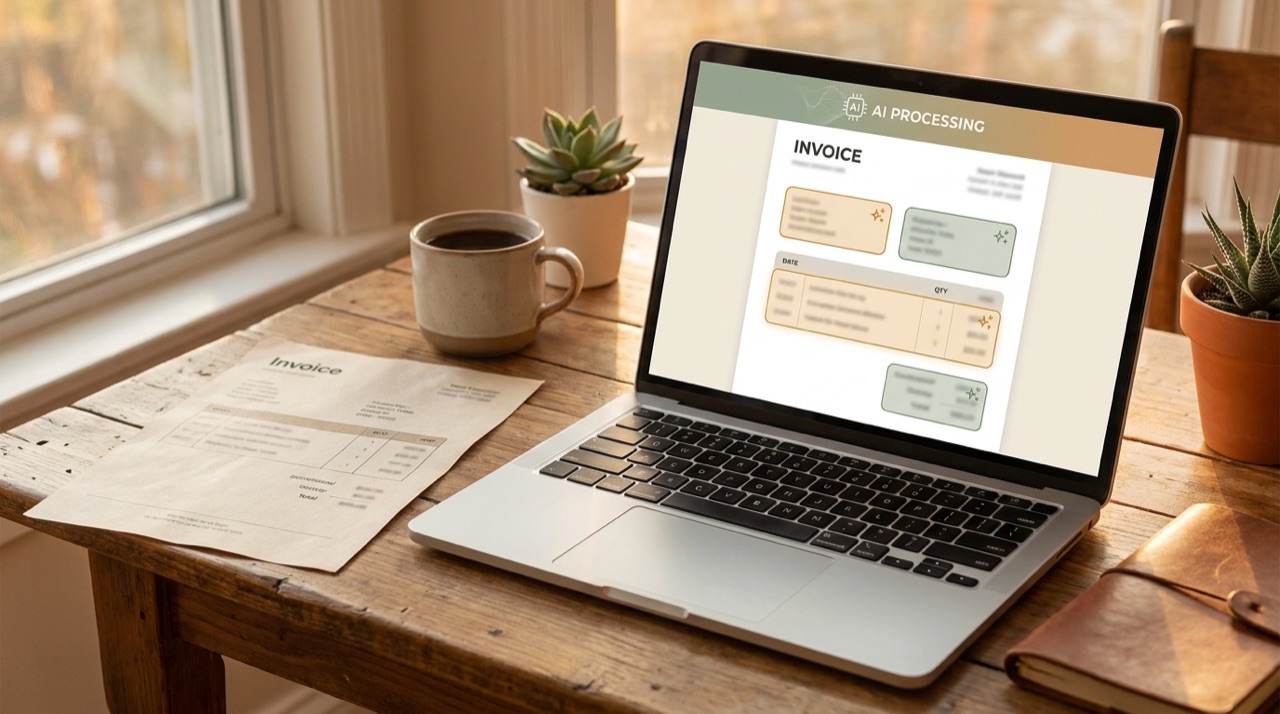
A laptop reading an invoice and extracting its fields into neat highlighted boxes.

AI can automate most of the data entry in small business bookkeeping — reading receipts and invoices, extracting the fields, suggesting account codes from your history, matching transactions to bank lines and flagging anomalies. It cannot take responsibility for the result, which is why every serious setup keeps a human approving before anything posts.

What it does well

  • Reading documents. Receipts, invoices and statements in varied formats, including photographs of crumpled paper.
  • Suggesting codes. After a few months of your decisions it categorises routine transactions with high accuracy.
  • Matching and reconciling. Pairing bank lines with invoices and receipts, and surfacing what does not match.
  • Spotting anomalies — duplicate invoices, an unusual amount from a familiar supplier, a subscription that quietly doubled.
  • Chasing. Automated reminders on overdue invoices, which is bookkeeping-adjacent and recovers real cash. See how to automate invoicing.
  • Answering questions about your own numbers, when connected properly to your accounting system.
Most of this is already inside mainstream accounting platforms. Before buying anything new, check what the software you pay for already does — the answer is frequently "most of it".

What still needs a person

  • Judgement calls — whether something is capital or expense, how to treat a mixed-use asset, what is genuinely deductible.
  • Tax filings and compliance. AI does not carry professional liability. Your accountant does.
  • Anything unusual — a one-off transaction, a restructure, a dispute.
  • Final approval before posting. This is money; the review step is not optional.
  • Advice. Structure, planning and the decisions that actually change your tax position.

Can ChatGPT do it?

No — not the chat window on its own. It cannot see your bank feed or your ledger, it is unreliable with arithmetic, and pasting financial records into a public tool is exactly the mistake to avoid. It is useful for explaining an accounting concept in plain language or drafting a note to your accountant. It is not a bookkeeping system, and treating it as one creates work rather than removing it.

The automation that works lives inside your accounting platform or in a purpose-built integration with permissions, an audit trail and human approval — not in a browser tab.

A sensible setup for a small business

  • Connect bank feeds properly so transactions arrive automatically.
  • Turn on receipt capture and make photographing a receipt the habit at the moment of purchase.
  • Let the software learn your coding, then review its suggestions weekly rather than re-entering everything.
  • Automate invoicing and reminders on the sales side.
  • Keep a human approval step before anything posts.
  • Keep your accountant for judgement, filings and advice — and give them cleaner data than before, which is where the real saving lands.

Done properly this removes hours of data entry a month without moving any risk onto software that cannot be accountable for it. If bookkeeping is the workflow eating your evenings, our free AI Opportunity Scan will tell you what is worth automating and what your existing software already covers.


Questions

Common questions

Can I use AI to do my bookkeeping?

AI can automate most of the data entry — reading receipts and invoices, extracting the fields, suggesting account codes based on your previous decisions, matching transactions to bank lines and flagging duplicates or anomalies. It cannot take professional responsibility for your accounts, make judgement calls such as capital versus expense treatment, or handle tax filings. The reliable pattern is that AI prepares the entries and a person approves them before anything posts.

Can ChatGPT do my bookkeeping?

No. ChatGPT cannot see your bank feed, your ledger or your accounting software, it is unreliable with arithmetic, and pasting financial records into a public AI tool is a data-handling mistake you should avoid. It is genuinely useful for explaining an accounting term in plain language or drafting a question to your accountant. Actual bookkeeping automation belongs inside your accounting platform or a purpose-built integration with an audit trail and human approval.

Will AI replace my accountant?

It is replacing the data entry, not the accountant. Categorising transactions, reading receipts and reconciling bank lines are increasingly automated, which removes hours of routine work. What remains firmly human is judgement on how transactions should be treated, responsibility for filings and compliance, handling anything unusual, and advice on structure and planning. In practice the common outcome is that your accountant receives cleaner data and spends their time on the work that actually affects your position.

Keep reading

More from the blog

A person watching a task complete by itself on a laptop at a sunlit desk.
AI basics · 6 min read

AI Agent vs AI Chatbot: What's the Difference?

A chatbot has a conversation. An AI agent takes actions across your systems and completes a task end to end. That difference decides whether you are buying a tool that deflects questions or one that removes work — and most businesses buy the wrong one.

Read the post →

A small brass padlock resting on a closed folder beside a laptop in warm light.
Safety & governance · 7 min read

Is Your Business Data Safe With AI?

The risk is not AI in the abstract — it's an employee pasting confidential data into a public tool whose terms let it be stored. Safety is a set of choices, not a property of the technology. Here's how to make the right ones.

Read the post →

Get started

Find the first AI system worth building.

Show us where your business is losing time, revenue, capacity or visibility. We will help determine whether AI can solve it — and what the first practical step should be.

hello@askgeeks.ai · Vancouver, BC · remote across Canada & the US